
What Is Generative AI? A Business Guide to Use Cases and Benefits (2026)
Generative AI for business has moved from hype to a practical tool that writes content, answers questions, generates code, and creates images in seconds. But behind the buzzwords, many leaders still ask a simple question: what is generative AI, and how can it actually help my company? This guide explains generative AI in plain language — what it is, how it works, where it delivers value, and how to adopt it responsibly in 2026.
What Is Generative AI?
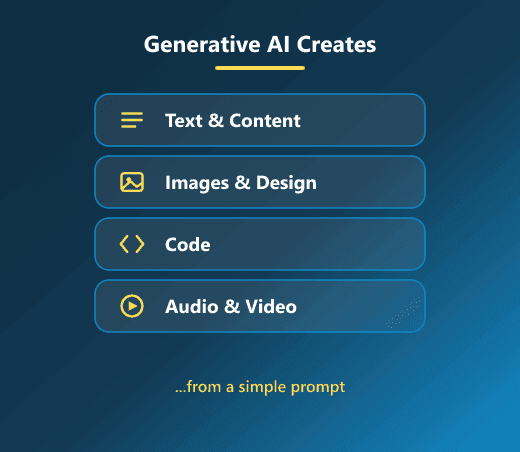
Generative AI is a type of artificial intelligence that creates new content — text, images, code, audio, or video — rather than just analysing existing data. Instead of only classifying or predicting, it produces original output that resembles what a human might make. When you ask a tool to draft an email, summarize a report, or generate a product image, that is generative AI at work.
Most modern generative AI is powered by large language models (LLMs) — systems trained on vast amounts of text and data so they can understand context and generate relevant, coherent responses. The same underlying idea extends to images, audio, and video through specialized models.
How Does Generative AI Work?
At a high level, a generative model learns patterns from a huge dataset during training. Once trained, it can take a prompt — a question or instruction — and predict, step by step, the most fitting output. The quality of what you get depends heavily on three things: the model, the prompt, and the data it can draw on. For business use, the third factor is critical: a generic model knows general knowledge, but it does not know your products, policies, or customers unless you connect it to your own data. That connection is usually made through a technique called Retrieval-Augmented Generation (RAG), which we will return to below.
Generative AI vs Traditional AI
Traditional AI is mostly about analysis — detecting fraud, forecasting demand, recommending products, or classifying images. Generative AI is about creation — producing new text, designs, or code on demand. The two are complementary: traditional AI tells you what is happening, while generative AI helps you act on it by drafting, designing, and communicating. Increasingly, generative AI also serves as the reasoning engine inside autonomous systems — if you want to see how that plays out, our guide on what an AI agent is explains how generative models power agents that take action.
Generative AI Use Cases for Business
The value of generative AI shows up across almost every function:
Turning these possibilities into reliable systems is exactly what professional generative AI development delivers — moving from a clever demo to a tool your team can depend on every day.
The Benefits of Generative AI
Done well, generative AI compresses work that used to take hours into minutes, lets small teams produce like large ones, and makes expertise available on demand. It lowers the cost of content and code, speeds up decision-making, and frees skilled people to focus on higher-value work. For many businesses, the biggest win is simply speed — shipping, responding, and creating faster than competitors who still do everything manually.
The Challenges (and How to Solve Them)
Generative AI is powerful, but it is not magic. Out of the box, a model can produce confident answers that are wrong ("hallucinations"), it does not know your private data, and it raises real questions about accuracy, security, and governance. The proven fix is to ground the model in your own trusted content through a Retrieval-Augmented Generation (RAG) pipeline, add guardrails, and keep a human in the loop for sensitive decisions. This is where careful engineering separates a risky experiment from a dependable business tool.
How to Get Started with Generative AI
Start small and specific. Pick one high-volume, low-risk use case — drafting support replies, summarizing documents, or generating first-draft marketing copy — and measure the time and cost it saves. Prove value on that first use case, then expand. If your goal is a system that also takes action, not just generates text, our step-by-step guide on how to build an AI agent shows how generative AI becomes the engine of real automation.
Building Generative AI Affordably
Building production-grade generative AI takes expertise across LLMs, data engineering, RAG, security, and integrations — a skill set that is expensive to hire in the US or Europe. This is why a growing number of global businesses partner with Pakistan-based AI teams that deliver the same quality at 40–60% lower cost, with modern generative and agentic expertise. For startups and enterprises alike, that combination of talent and budget efficiency is what makes ambitious AI projects viable.
Frequently Asked Questions
What is the difference between generative AI and a large language model?
A large language model (LLM) is the underlying technology that powers most generative AI for text. Generative AI is the broader category that also includes image, audio, and video generation. In short, LLMs are one engine behind generative AI.
Is generative AI safe to use for business?
Do I need my own data to use generative AI?
How much does generative AI development cost?
Ready to Put Generative AI to Work?
Yes, when built responsibly. Grounding the model in your own data with a RAG pipeline, adding guardrails, and keeping humans in the loop for sensitive decisions makes generative AI accurate and safe enough for real business use.
For general tasks, no. But to get answers specific to your business — your products, policies, and customers — you connect the model to your data through a RAG pipeline. That is what makes the output accurate and trustworthy.
It depends on scope and integrations. Partnering with a Pakistan-based team can reduce costs by 40–60% compared to Western agencies while maintaining quality, making it far more accessible for startups and enterprises.
Whether you want to automate content, support, or a full workflow, the right approach turns generative AI from a novelty into real business value. Explore our generative AI development services or talk to our team and we will help you find the highest-impact place to start.
Explore Our Services
Ready to turn these ideas into working software? Our engineering team can help.
AI Agent Development
Autonomous AI agents that automate workflows and scale your operations.
Learn more →Generative AI Development
Custom LLM copilots, content engines and RAG systems built for production.
Learn more →AI Enterprise Integration
AI that plugs into your existing ERP, CRM and procurement stack — integration, not rip-and-replace.
Learn more →All AI & Software Services
Explore our full range of AI, web, cloud and custom software engineering.
Learn more →Start a Project
Book a free discovery call and scope the highest-ROI build for your business.
Learn more →