
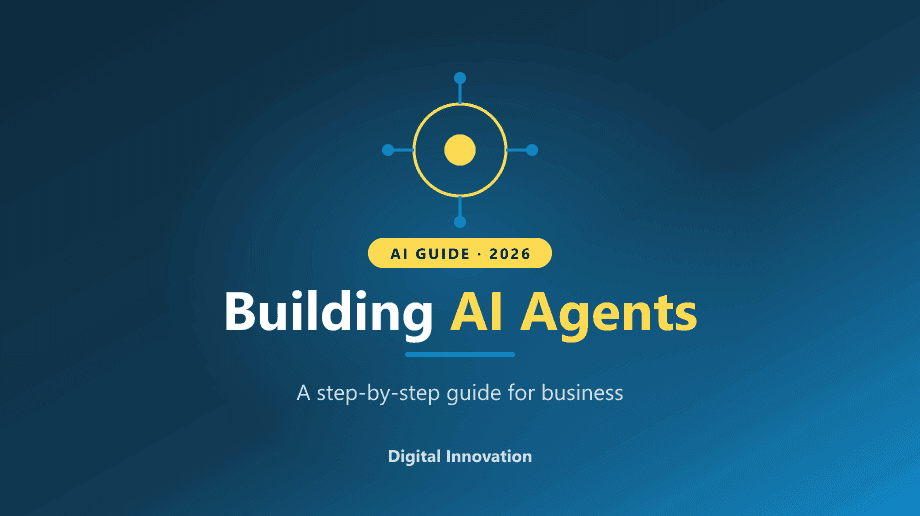
How to Build an AI Agent for Your Business: A 2026 Step-by-Step Guide
AI agent development has become one of the fastest-growing ways for businesses to automate complex work, cut operational costs, and scale support without hiring more people. But going from "we want an AI agent" to a working system that actually delivers value is where most teams get stuck. This guide walks you through exactly how to build an AI agent for your business in 2026 — the concepts, the steps, the tech stack, and the real-world decisions that determine whether your project succeeds or stalls.
What Is an AI Agent (and How Is It Different from a Chatbot)?
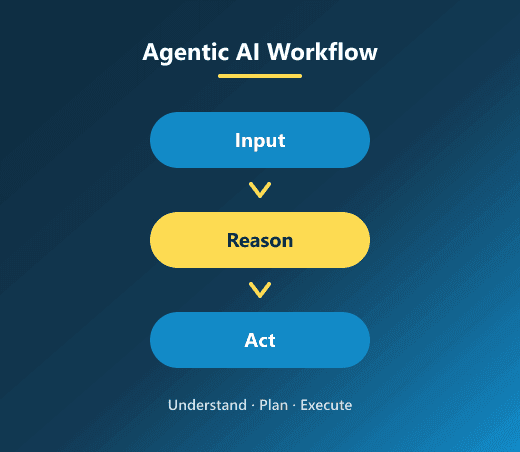
An AI agent is a software system that can understand a goal, make decisions, use tools, and take actions to complete a task — with little or no human intervention. Unlike a traditional chatbot, which follows scripted rules and can only answer questions, an AI agent can reason about a problem, break it into steps, call external tools or APIs, and adapt when something changes.
Think of the difference this way: a chatbot tells a customer "here is our refund policy." An AI agent actually processes the refund — it looks up the order, checks eligibility, issues the payment, and updates the CRM. That shift from answering to doing is what makes agentic AI so valuable for modern businesses.
Why Businesses Are Investing in AI Agents in 2026
The demand is being driven by hard economics:
From e-commerce and FinTech to healthcare and logistics, companies across the US, Europe, and the Middle East are moving AI agents from experiment to production.
Step 1 — Define the Job Before You Define the Technology
The biggest mistake teams make is starting with the model instead of the problem. Before writing a single line of code, answer three questions: What specific outcome should the agent produce? What does success look like in measurable terms — resolution rate, time saved, cost per task? And where are the boundaries between what the agent can do autonomously and what must be escalated to a human? A narrow, well-defined agent that does one job well beats an ambitious "do everything" agent that does nothing reliably.
Step 2 — Choose the Right Model and Architecture
Modern AI agents are built on large language models (LLMs) as the reasoning engine. The key architectural pieces include the LLM itself, an orchestration framework (such as LangGraph, CrewAI, or AutoGen) that manages how the agent plans and calls tools, a memory layer (often a vector database) so the agent remembers relevant history, and the tools and integrations the agent can act on — your CRM, payment gateway, or ticketing system.
For knowledge-heavy agents, you will often pair the model with a Retrieval-Augmented Generation (RAG) pipeline so the agent answers from your data instead of guessing. This is where careful generative AI development turns a generic model into a system that truly understands your business.
Step 3 — Connect the Agent to Your Tools and Data
An AI agent is only as useful as what it can access and act on. This stage involves securely connecting the agent to the knowledge it needs (docs, product catalogs, policies), giving it permission to trigger real actions through APIs, and adding guardrails — validation, rate limits, and permission checks — so it cannot take harmful or out-of-scope actions. This is the most engineering-intensive step, and it is where a lot of DIY projects break down, because integrating with real production systems safely requires experienced developers.
Step 4 — Add Human-in-the-Loop Controls
Full autonomy sounds impressive, but the smartest deployments keep a human in the loop for high-stakes decisions. Design your agent so that low-risk actions run automatically, while sensitive ones — large refunds, contract changes, data deletion — pause for human approval. This builds trust, reduces risk, and lets you expand autonomy gradually as confidence grows.
Step 5 — Test, Measure, and Improve
Before going live, test the agent against real scenarios, including the messy edge cases. After launch, monitor the metrics you defined in Step 1, review failed or escalated cases, and refine the prompts, tools, and logic. AI agents improve fastest when they are treated as living systems, not one-time builds.
Build In-House or Hire an AI Agent Development Company?
Building a production-grade AI agent requires expertise across LLMs, orchestration frameworks, data engineering, security, and integrations — a rare combination that is expensive to hire for in-house. That is why many businesses partner with a specialized AI agent development company to move faster and avoid costly mistakes.
Why Global Businesses Choose Pakistan-Based AI Development Teams
Here is a shift that is reshaping how companies build AI in 2026: instead of paying premium US or European rates, a growing number of businesses are partnering with skilled AI development teams in Pakistan — and getting the same quality for a fraction of the cost. Pakistan-based teams deliver world-class engineering at 40–60% lower cost than Western agencies, work daily with the latest LLM, agentic, and cloud stacks, and offer timezone overlap with the Middle East, Europe, and the US.
For a startup validating an AI product or an enterprise scaling automation, a Pakistan-based partner offers a rare combination of top engineering talent and budget efficiency — which is exactly why "AI agent development company in Pakistan" has become a smart search for global buyers. Teams like Digital Innovation already serve 100+ clients across the US, Europe, and the Middle East from this model.
Frequently Asked Questions
How long does it take to build an AI agent?
A focused, single-purpose agent can reach a working prototype in 3–6 weeks. Production-grade agents with deep integrations and guardrails typically take 2–4 months, depending on complexity.
How much does it cost to build an AI agent?
Do I need my own data to build an AI agent?
Can an AI agent integrate with my existing software?
Ready to Build Your AI Agent?
Cost depends on scope, integrations, and whether you build in-house or partner with an agency. Working with a Pakistan-based team can reduce costs by 40–60% compared to Western rates while maintaining quality.
For knowledge-based agents, yes — connecting the agent to your data through a RAG pipeline is what makes it accurate and specific to your business. For action-based agents, you will need access to the systems it should operate.
Yes. A well-built agent connects to your CRM, ERP, support desk, payment systems, and internal tools through APIs — that is what turns it from a demo into a real business tool.
Whether you are automating support, streamlining operations, or launching an AI-powered product, the right partner makes all the difference. Explore our AI agent development services or talk to our team to scope your project — from idea to production-ready agent.
Explore Our Services
Ready to turn these ideas into working software? Our engineering team can help.
AI Agent Development
Autonomous AI agents that automate workflows and scale your operations.
Learn more →Generative AI Development
Custom LLM copilots, content engines and RAG systems built for production.
Learn more →AI Enterprise Integration
AI that plugs into your existing ERP, CRM and procurement stack — integration, not rip-and-replace.
Learn more →All AI & Software Services
Explore our full range of AI, web, cloud and custom software engineering.
Learn more →Start a Project
Book a free discovery call and scope the highest-ROI build for your business.
Learn more →