
How to Build a Production-Ready RAG Pipeline (2026 Engineering Guide)
Building a production-ready RAG pipeline means solving retrieval quality, chunking strategy, reranking and evaluation — not just wiring an LLM to a vector database. This engineering guide walks through the architecture, the tuning decisions that actually moved accuracy, and the monitoring that keeps a retrieval-augmented generation system honest once real users depend on it.
Retrieval-augmented generation is now the default way to put a large language model on top of private business knowledge. It is also the stage where most AI projects quietly stall. A prototype that answers ten curated questions convincingly can fall apart the moment it faces two million vectors, thousands of queries a day, and a knowledge base that changes every week. If you are still deciding whether RAG is the right approach for your organisation, our business guide to retrieval-augmented generation covers the commercial case. This article is about what happens after that decision — the engineering.
Why RAG Is Harder Than It Looks
RAG wins over fine-tuning whenever customer-facing knowledge has to stay current. Retraining a model every time a policy document changes is neither affordable nor fast; swapping a document in a vector index is both. That advantage is real, but it comes with a cost that rarely appears in tutorials: every component in the pipeline has its own production failure mode, and those failures compound.
An embedding model that is subtly wrong for your domain retrieves plausible but irrelevant passages. A chunking strategy that splits mid-argument hands the model half a thought. A retriever tuned purely for similarity returns five near-identical paragraphs and starves the answer of context. None of these fail loudly. They simply produce answers that are confidently, unremarkably wrong.
The Architecture That Held Up in Production
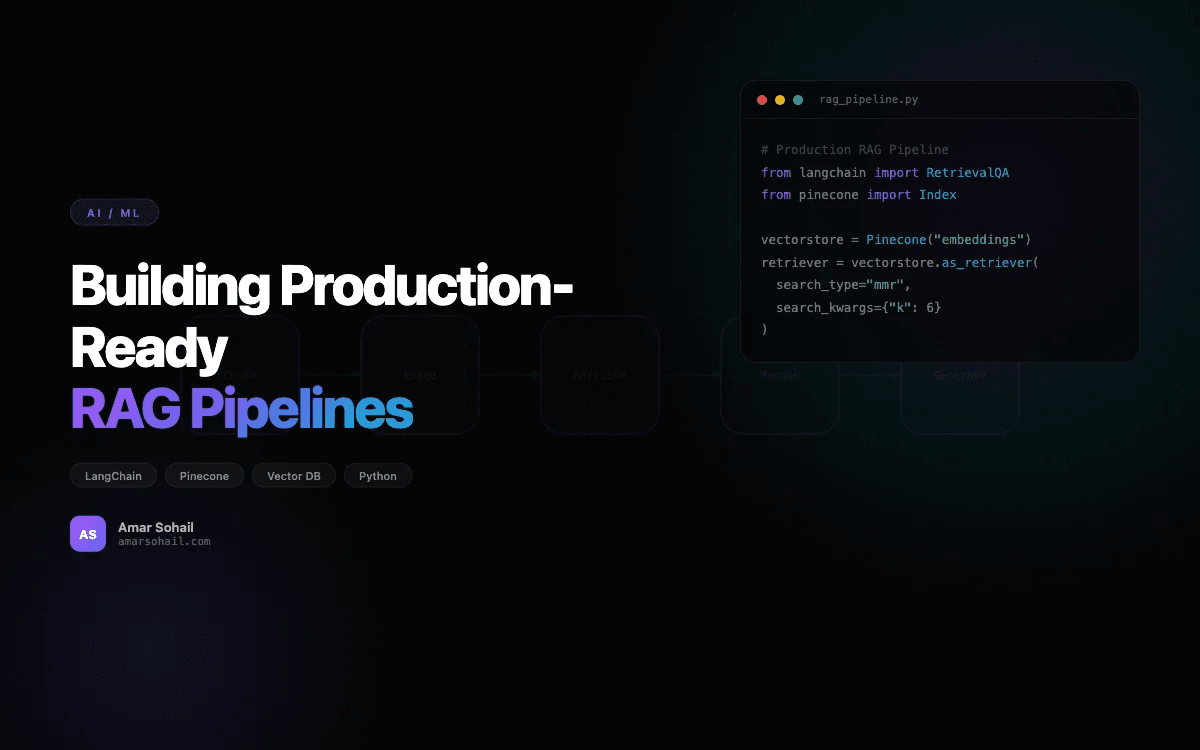
After three rewrites, the shape that proved durable across eight months of production traffic was deliberately unexciting: OpenAI embeddings feeding a Pinecone index queried with Maximal Marginal Relevance, served through an async FastAPI layer running on Kubernetes.
Each layer earns its place. The embedding model determines what "similar" means. The vector store determines how fast and how isolated retrieval is. The retrieval strategy determines what actually reaches the prompt. The service layer determines whether users wait three seconds or four hundred milliseconds. Getting one right while ignoring the others produces a system that is impressive in a demo and disappointing in production.
Chunking: Where Most RAG Pipelines Quietly Fail
Default text-splitter settings are the single most common cause of poor retrieval quality. A fixed chunk size applied uniformly across contracts, FAQs, and technical manuals guarantees that at least one of those document types is being butchered.
Moving to document-type-specific chunking — roughly 800 to 1,500 characters with 100 to 300 characters of overlap, tuned per format — and prepending each chunk with its document title and section header cut "wrong document, right topic" errors by 40%. The header prefix matters more than the size tuning: it gives an otherwise orphaned paragraph the context a human reader would have had from the page around it.
Choosing a Vector Database
Pinecone, Weaviate, Chroma and Qdrant will all serve a proof of concept adequately. The differences surface at operational scale, and the deciding factor was namespace isolation — the ability to hold multiple embedding-model versions side by side in the same index.
That capability turns embedding migrations from an outage into a routine deployment. When moving from text-embedding-ada-002 to text-embedding-3-small, the new vectors were written to a fresh namespace, evaluated against the old ones on identical queries, and promoted only once they measured better. No downtime, no irreversible step.
Retrieval Tuning: MMR Over Pure Similarity
Pure similarity search optimises for the wrong thing. Ask it for the top five passages and it will happily return five paraphrases of the same paragraph, because they are all genuinely similar to the query. The model then answers from a single narrow slice of the knowledge base.
Maximal Marginal Relevance trades a little relevance for diversity, and at lambda_mult=0.7 the balance held well across query types. The prompt receives passages that cover the question from several angles rather than five copies of one.
Adding a Reranker
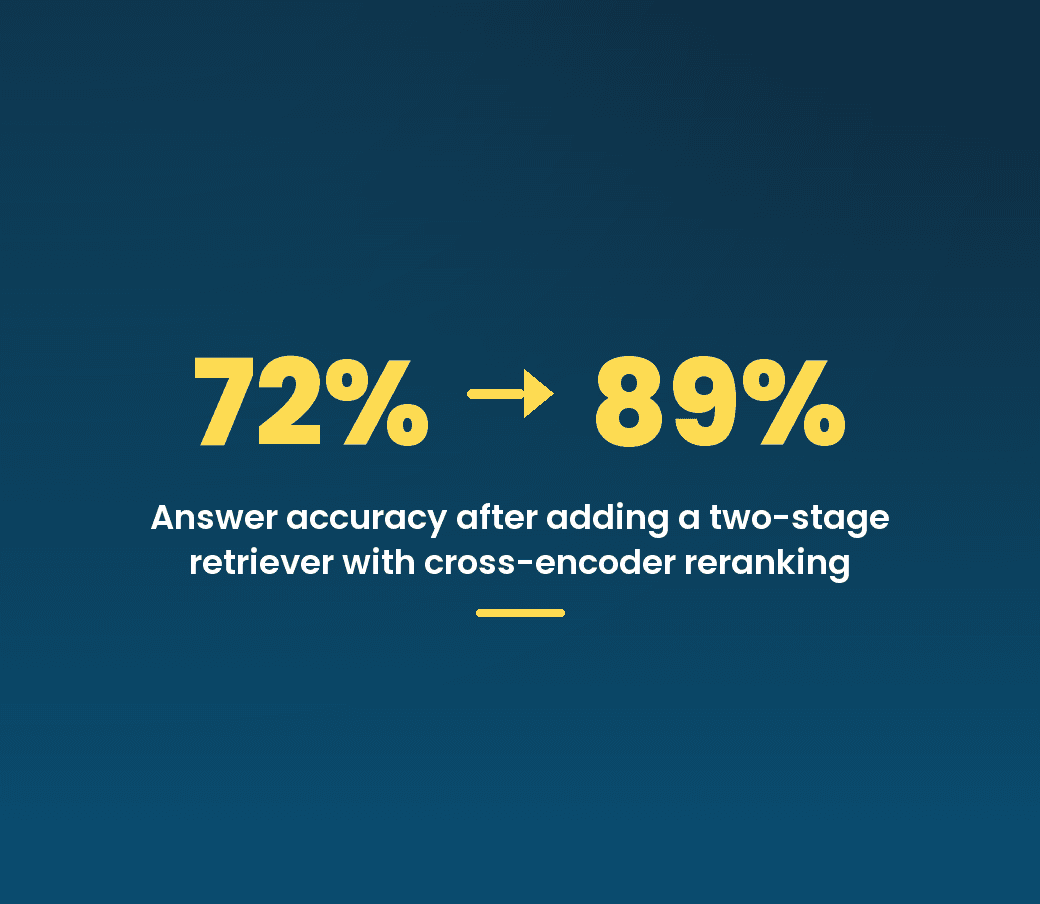
The largest single accuracy gain came from splitting retrieval into two stages: fetch twenty candidates, narrow to six with MMR, then rerank to the final four with a cross-encoder. End-to-end answer accuracy moved from 72% to 89%.
The reason is architectural. Bi-encoders — what a vector search uses — embed the query and the document separately, so they can only ever approximate the relationship between them. A cross-encoder such as cross-encoder/ms-marco-MiniLM-L-6-v2 reads query and passage together and scores the pair directly. It is far too slow to run across an entire index, which is exactly why it belongs in a second stage over a shortlist.
Prompt Engineering for Retrieval
A RAG prompt has one job that a general prompt does not: it must make clear that the supplied context is the only permissible source of truth. Adding explicit constraints — answer only from the provided context, state plainly when the context is insufficient, and cite the source document for every claim — cut hallucinations by roughly 50%.
The instruction not to guess does most of the work. Without it, a model handed thin context will reliably fill the gap from its training data, and the resulting answer is indistinguishable in tone from a correct one.
The Service Layer and Semantic Caching
Async streaming responses through FastAPI change how the latency feels: users see tokens arrive immediately rather than waiting for a complete answer. Underneath, a semantic Redis cache at a 0.95 similarity threshold serves near-duplicate questions without a round trip to the model.
Median latency fell from 3.2 seconds to 400 milliseconds on cache hits, and LLM spend dropped 30%. In any real deployment a surprising share of traffic is the same handful of questions asked slightly differently — semantic caching is what turns that observation into a cost line.
LangChain or LlamaIndex?
For pure document question answering, LlamaIndex is the cleaner abstraction and will get you there with less code. LangChain earns its complexity when the retrieval pipeline is one component among several — when the same service also calls tools, routes between models, or hands off to an agent. If your roadmap points toward AI agent development, that composability is worth the extra surface area.
Monitoring and Evaluation in Production
Key Takeaways
A RAG system cannot be evaluated once at launch. Retrieval quality drifts as documents are added, and nothing in the stack will tell you unprompted. Three measurements proved sufficient:
A nightly evaluation harness runs 200 question-and-answer pairs and alerts when answer accuracy drops below 85%. It has caught regressions from document ingestion changes that no unit test would have flagged.
RAG rewards engineering discipline more than novelty. The components are well understood and widely available; the difference between a demo and a dependable system is in the chunking strategy, the second retrieval stage, and the evaluation loop that catches drift before users do.
If you are planning a retrieval system on your own knowledge base, our team builds and operates these pipelines end to end — from ingestion and embedding strategy through to evaluation harnesses and cost tuning. Explore our generative AI development services or get in touch to talk through your use case.
Explore Our Services
Ready to turn these ideas into working software? Our engineering team can help.
AI Agent Development
Autonomous AI agents that automate workflows and scale your operations.
Learn more →Generative AI Development
Custom LLM copilots, content engines and RAG systems built for production.
Learn more →AI Enterprise Integration
AI that plugs into your existing ERP, CRM and procurement stack — integration, not rip-and-replace.
Learn more →All AI & Software Services
Explore our full range of AI, web, cloud and custom software engineering.
Learn more →Start a Project
Book a free discovery call and scope the highest-ROI build for your business.
Learn more →