
What Is Retrieval-Augmented Generation (RAG)? A Business Guide (2026)
Retrieval-Augmented Generation (RAG) has quietly become one of the most important techniques in applied AI, because it solves the single biggest problem businesses face with large language models: getting accurate answers from their own data. If you have ever wondered how to make an AI assistant that actually knows your products, policies, and documents — instead of guessing — RAG is the answer. This guide explains what RAG is, how it works, and why it matters for your business in 2026.
What Is Retrieval-Augmented Generation (RAG)?
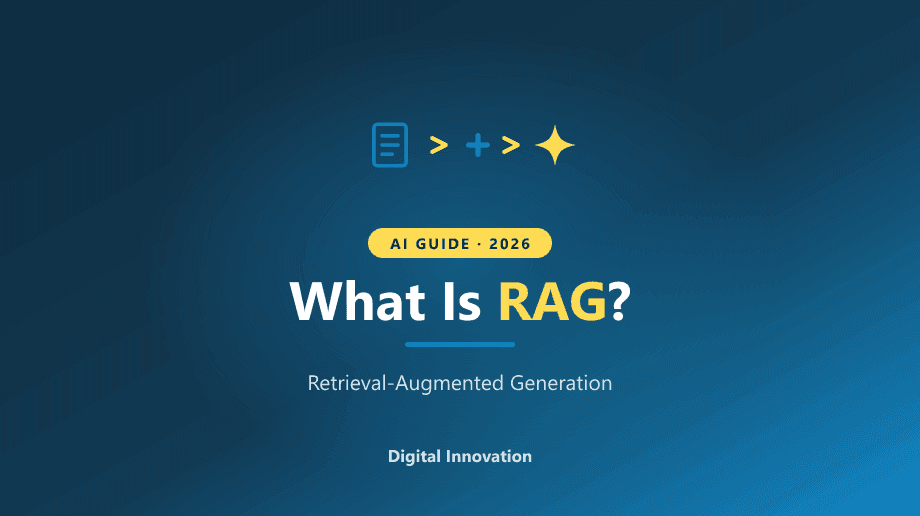
RAG is a technique that connects a large language model (LLM) to an external source of trusted information — your documents, database, or knowledge base — so it can retrieve relevant facts before it generates an answer. Instead of relying only on what the model learned during training, a RAG system looks up the right information in real time and uses it to produce a grounded, accurate response.
Think of it like the difference between answering from memory and answering with an open book. A plain LLM answers from memory, which can be outdated or wrong. A RAG-powered system checks the book first — your book — and then answers.
Why Do LLMs Need RAG?
Large language models are powerful, but on their own they have three big limitations for business use. First, they do not know your private data — your pricing, contracts, or internal docs. Second, their knowledge has a cutoff date, so recent information is missing. Third, when they do not know something, they can produce confident but incorrect answers, known as "hallucinations." RAG addresses all three by grounding the model in current, trusted, company-specific information every time it answers.
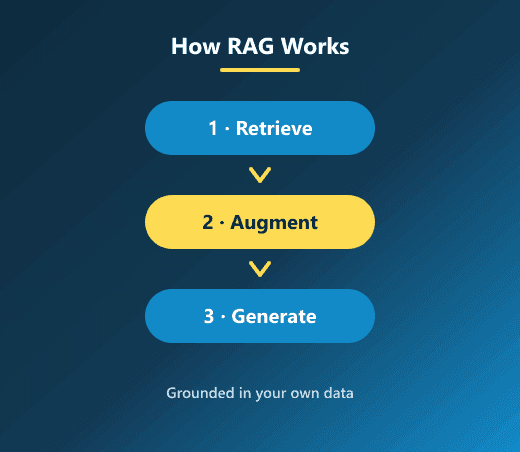
How Does RAG Work?
A RAG pipeline runs in three broad steps:
Getting each stage right — clean data, smart chunking, good retrieval, and solid guardrails — is what separates a reliable system from a flaky one, and it is the core of professional generative AI development.
RAG vs Fine-Tuning: What's the Difference?
A common question is whether to use RAG or to fine-tune a model. Fine-tuning changes the model's internal weights by training it further on your data — useful for teaching style, tone, or narrow tasks, but expensive and slow to update. RAG leaves the model as-is and feeds it fresh information at query time — cheaper, faster to update, and easier to keep accurate. For most business knowledge use cases, RAG is the better starting point, and the two can even be combined. If you want the bigger picture of how these pieces fit together, our guide on what generative AI is puts RAG in context.
RAG Use Cases for Business
RAG shines anywhere accurate, source-backed answers matter:
The Benefits of RAG
RAG gives you accuracy (answers grounded in your real data), freshness (update the knowledge base, not the model), transparency (responses can cite their sources), and lower cost (no expensive retraining every time your information changes). For most companies, that combination is what turns a promising AI demo into a system people actually trust.
Building a RAG System the Right Way
A production RAG system involves more than plugging an LLM into a database. It requires clean and well-structured data, a good chunking and embedding strategy, a reliable vector store, retrieval tuning, and guardrails to prevent bad answers. RAG is also the knowledge layer that powers most capable AI agents — so if your goal is an assistant that both knows your data and takes action, our guide on how to build an AI agent shows how RAG fits into the bigger system.
Building RAG Affordably
Because RAG spans data engineering, embeddings, vector databases, LLMs, and security, the expertise is expensive to hire in the US or Europe. A growing number of global businesses partner with Pakistan-based AI teams that build production-grade RAG and AI agent systems at 40–60% lower cost, without compromising on quality — making accurate, data-grounded AI accessible to startups and enterprises alike.
Frequently Asked Questions
Is RAG better than fine-tuning?
For most business knowledge use cases, yes. RAG is cheaper, faster to update, and keeps answers accurate by pulling fresh data at query time. Fine-tuning is better for teaching style or narrow tasks, and the two can be combined.
Do I need a vector database for RAG?
Does RAG stop AI hallucinations?
How much does it cost to build a RAG system?
Ready to Ground Your AI in Your Own Data?
Usually, yes. A vector database stores your documents as embeddings so the system can find the most relevant information by meaning, not just keywords. It is a core part of most RAG pipelines.
RAG dramatically reduces them by grounding answers in your trusted data, and it lets responses cite sources. Combined with guardrails, it makes AI reliable enough for real business use, though good design still matters.
It depends on data volume and integrations. Partnering with a Pakistan-based team can cut costs by 40–60% versus Western agencies while maintaining quality, making RAG accessible for most budgets.
If you want an AI assistant that answers accurately from your documents, RAG is the way to get there. Explore our generative AI development services or talk to our team and we will help you design a RAG system that turns your knowledge into reliable, instant answers.
Explore Our Services
Ready to turn these ideas into working software? Our engineering team can help.
AI Agent Development
Autonomous AI agents that automate workflows and scale your operations.
Learn more →Generative AI Development
Custom LLM copilots, content engines and RAG systems built for production.
Learn more →AI Enterprise Integration
AI that plugs into your existing ERP, CRM and procurement stack — integration, not rip-and-replace.
Learn more →All AI & Software Services
Explore our full range of AI, web, cloud and custom software engineering.
Learn more →Start a Project
Book a free discovery call and scope the highest-ROI build for your business.
Learn more →