
Custom CRM/ERP or Customise Dynamics, Odoo and NetSuite? An Honest Guide
Custom CRM and ERP development is the wrong answer more often than software companies admit. If Microsoft Dynamics 365, Odoo, NetSuite or Salesforce already covers most of how your business runs, customising one of them will usually beat building from scratch — and this guide gives you the test we use to decide, along with the cases where a custom build genuinely wins.
We build custom software for a living, so this article argues against our own short-term interest in most of the scenarios below. We publish it anyway, because the fastest way to lose a client is to sell them an eighteen-month build they did not need, and the fastest way to earn one is to be the firm that said so before the contract was signed.
Start From the Default: Customise the Platform
The honest default is that you should configure an existing platform, not commission a new one. Dynamics 365, Odoo, NetSuite and Salesforce each represent years of work on the unglamorous parts of business software — tax handling, multi-currency, audit trails, permissions, reporting, mobile apps, integrations, and the compliance updates that arrive every time a government changes a rule. None of that is a competitive advantage for you. All of it is expensive to rebuild and, worse, expensive to keep rebuilding.
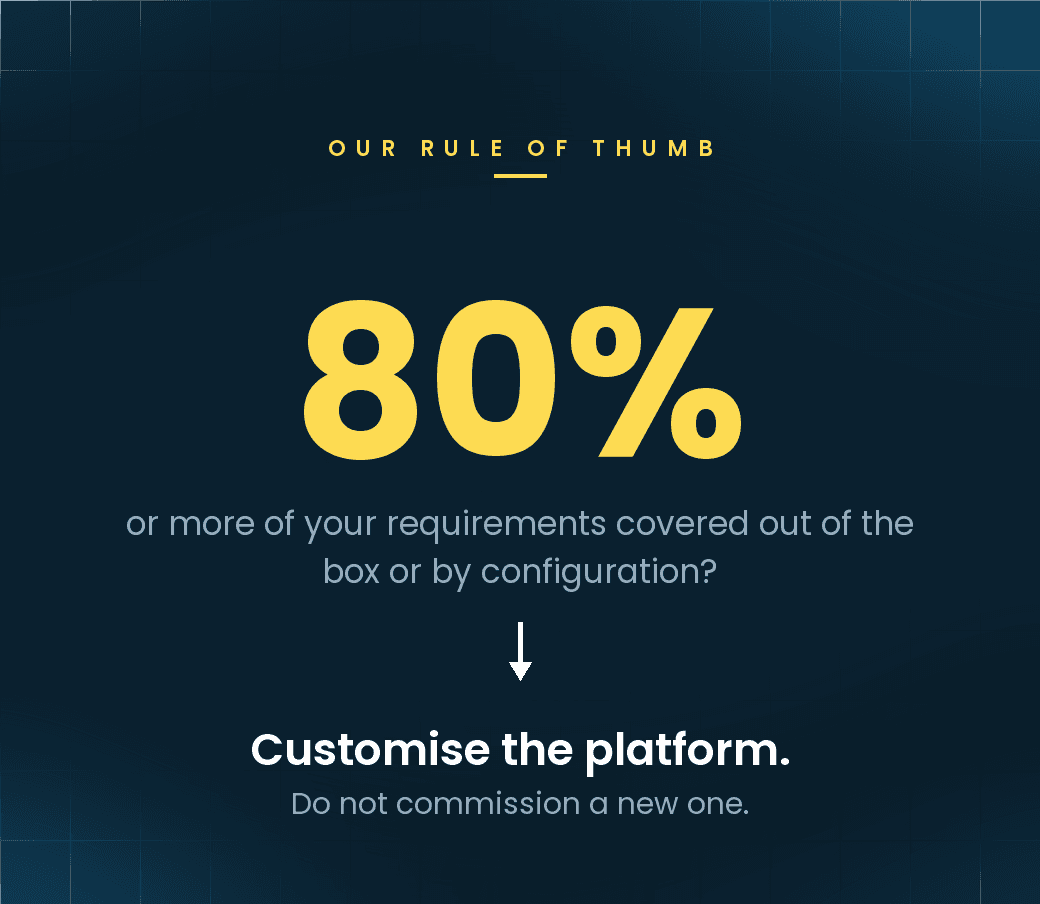
Our rule of thumb: if roughly 80% or more of your requirements are covered by a platform out of the box or through configuration, customise the platform. That figure is our own working threshold rather than a research finding, but it holds up well in practice. Below that line the workarounds start to outnumber the features, and the platform stops being a shortcut.
The Test That Settles It
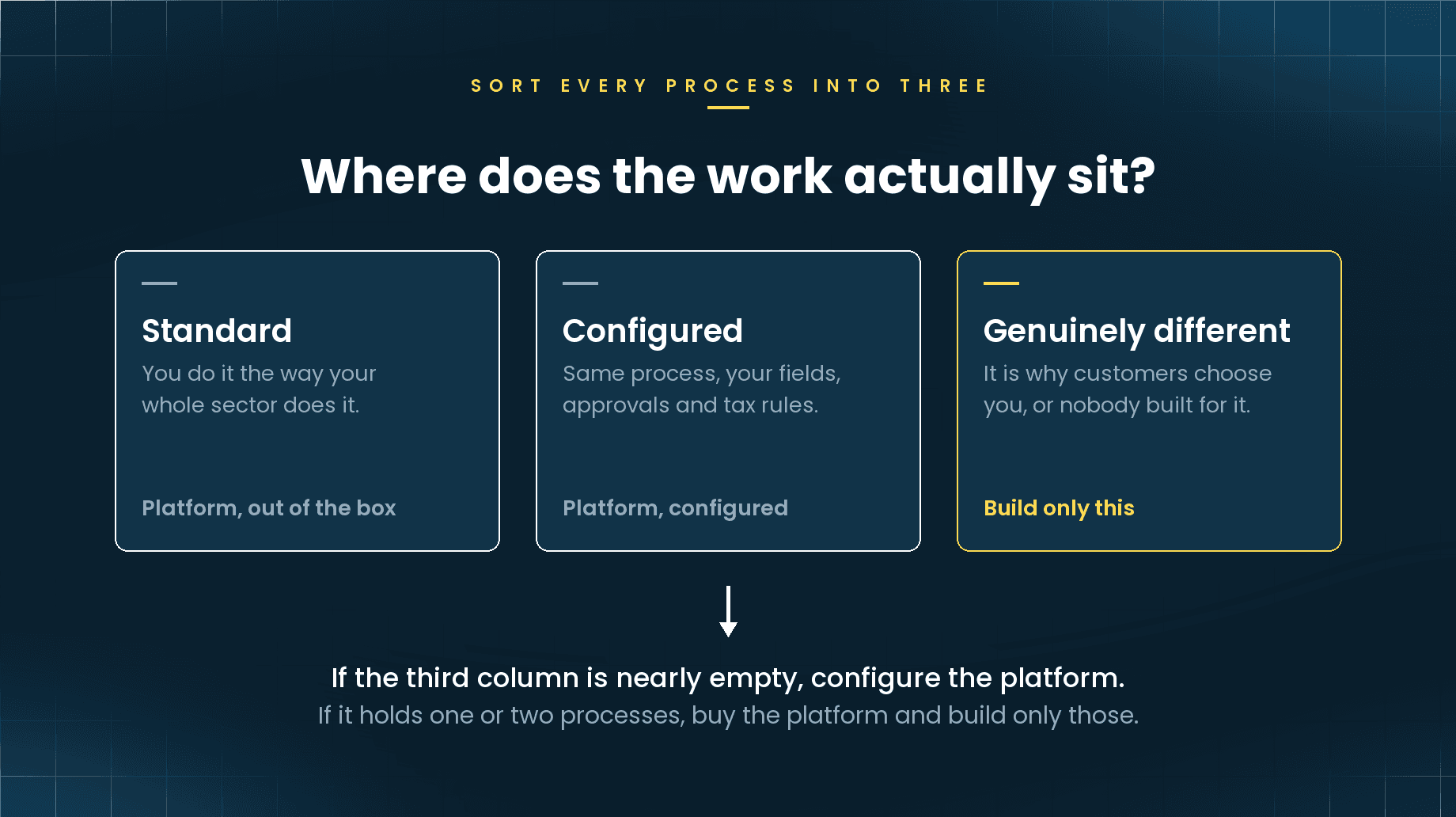
Before comparing vendors, write down how your business actually runs — not the org chart, the processes. Quote to cash. Procurement to payment. Onboarding a customer. Onboarding a supplier. Closing the month. Then sort every one of them into three buckets.
The decision follows from the third bucket alone. If it is nearly empty, buy and configure. If it holds one or two processes, buy the platform and build only those. If it holds the majority of what makes you money, you have a case for custom — and you should still read the section on hidden costs before acting on it.
What the Major Platforms Are Actually Good At
Vendor comparison tables tend to be written by whoever is selling. Here is the short, opinionated version, framed by the kind of business each platform suits rather than by feature counts.
Microsoft Dynamics 365
Strongest where the organisation already runs on Microsoft — Entra ID for identity, Teams for collaboration, Power BI for reporting, Excel for everything else. The Power Platform gives non-developers a legitimate route to building internal apps and automations on top of your business data. It suits mid-market and enterprise organisations with an IT function capable of governing what gets built. It is heavier to administer than the marketing suggests.
Odoo
The most flexible of the group and the friendliest to smaller and mid-sized businesses, particularly those that want manufacturing, inventory, purchasing and accounting in one place without enterprise pricing. Because much of it is open source you can genuinely extend the platform rather than working around it. The trade-off is that quality varies across the module ecosystem, and heavy customisation makes version upgrades a real project rather than a routine one.
NetSuite
A strong fit for multi-entity, multi-currency finance operations that have outgrown small-business accounting — distributors, wholesalers and product companies with real consolidation requirements. It is genuinely capable in the areas it targets and correspondingly expensive. It rewards businesses whose complexity is financial rather than operational.
Salesforce
Best understood as a CRM and application platform rather than an ERP. If your differentiation lives in sales, service and customer relationships, and your finance and operations run elsewhere, it is hard to beat. Costs scale with seats and add-on clouds, so it rewards businesses with a high revenue per user and punishes those needing to license large numbers of light-touch users.
When Custom Is Genuinely the Right Call
Custom development earns its place when one or more of the following is true. Note that none of them is "the platform does not do exactly what we want" — that is a configuration conversation, not a build one.
A worked example from our own portfolio: the B2B trading platform we built for a Dubai client had verified supplier onboarding, competitive bidding, counterparty scoring and an escrow-backed settlement flow at its centre — dealers transacting with dealers, most of whom had never met. No procurement suite is built for that shape. We have written up what we built and, just as importantly, which parts were reusable and which were not, in the Hyves B2B trade platform case study.
The Costs Each Side Hides
The upgrade tax on a heavily customised platform
Configuration is cheap. Deep customisation is not, and the bill arrives late. Every modification to core behaviour is something that must be retested, and occasionally rebuilt, each time the vendor ships a major release. Businesses that customise aggressively often end up postponing upgrades, which is how a platform chosen for its maintenance advantages quietly becomes legacy software with a licence fee attached.
The maintenance floor on custom software
Custom systems have no licence fee and no free improvements either. Someone has to apply security patches, upgrade dependencies, handle a payment provider's API change, and answer the phone when it breaks at month end. Budgeting for a build without budgeting for the years after it is the single most common way custom projects turn into regret. If you cannot fund ongoing ownership, buy the platform.
The Answer That Usually Wins
In practice the strongest position is rarely all-or-nothing. It is a platform of record — Dynamics, Odoo, NetSuite or whichever fits your finance and operations — plus a custom layer covering only the processes in that third bucket, integrated properly so that neither side holds a stale copy of the truth.
This keeps the commodity work commoditised and puts your engineering budget where it changes outcomes. It is also where most of our own enterprise work now sits: building against systems clients already run rather than replacing them. That approach is set out on our enterprise AI integration page. If part of that custom layer is meant to be autonomous rather than merely automated, the governance and approval questions it raises are covered separately in our guide to agentic AI in production.
Two warnings on the hybrid model. First, integration is the project, not an afterthought — decide early which system owns each piece of data, and be strict about it. Second, resist the temptation to let the custom layer grow into a second ERP. If it starts acquiring its own invoicing and permissions, you have quietly commissioned the build you were trying to avoid.
Questions to Ask Before You Sign
How We Approach It
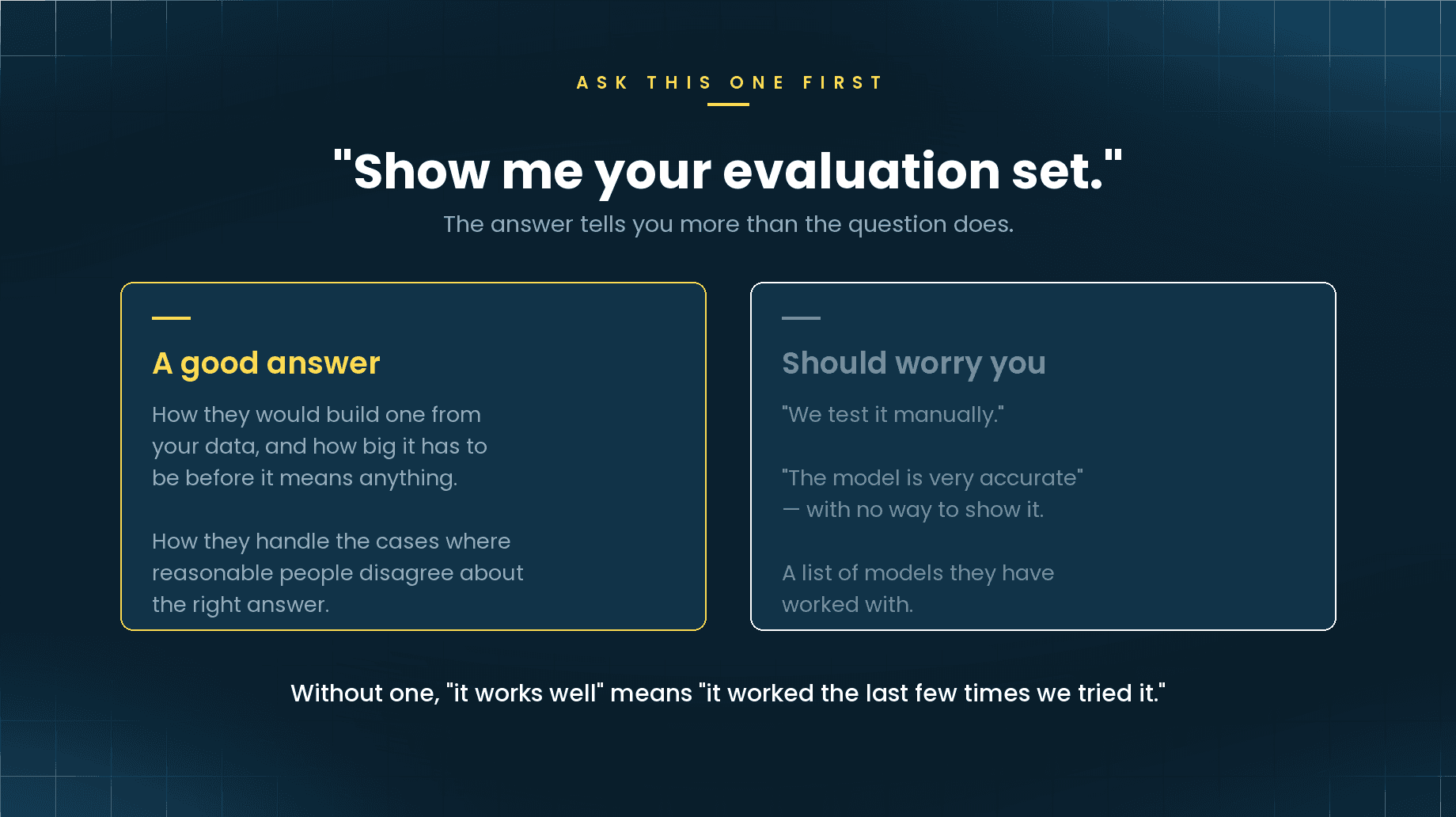
Whether you are talking to a platform partner or a development firm, these questions separate a considered proposal from a sales pitch.
That last question is the useful one. A partner who cannot name a scenario in which their own proposal is the wrong choice has not thought about your business, only about the contract.
We start with a paid discovery phase — process mapping, the three-bucket exercise above, and a written recommendation — before anyone writes code. Sometimes that recommendation is a custom build. Frequently it is "configure Odoo, and build only the two processes that make you different." Occasionally it is that the project should not happen this year at all.
If you are weighing this decision now, tell us how the process works in your business today. We will tell you which parts an existing platform already solves, which genuinely need building, and roughly what that costs — and if we are not the right fit for it, we will say so.
Explore Our Services
Ready to turn these ideas into working software? Our engineering team can help.
AI Agent Development
Autonomous AI agents that automate workflows and scale your operations.
Learn more →Generative AI Development
Custom LLM copilots, content engines and RAG systems built for production.
Learn more →AI Enterprise Integration
AI that plugs into your existing ERP, CRM and procurement stack — integration, not rip-and-replace.
Learn more →All AI & Software Services
Explore our full range of AI, web, cloud and custom software engineering.
Learn more →Start a Project
Book a free discovery call and scope the highest-ROI build for your business.
Learn more →